
01 Oct Late Accounts in Malaysia: What Happens After SSM EOT Is Approved?
By Kent Chia, Chartered Accountant (Malaysia), Managing Proprietor, KS Chia & Associates (AF001828)
Published: 01/10/2026
SHORT ANSWER
If your company’s accounts are already late, first check whether there is still enough time to complete the audit before the SSM circulation deadline. If not, the practical next step is usually to apply for an SSM extension of time (EOT), then work backwards from the revised deadline to complete the audit, MBRS filing, Form C and MITRS submission.
For a private company, the SSM EOT application should generally be made at least 7 days before the end of the 6-month circulation period. Once the extension is approved, the priority is to get the audit completed and the financial statements lodged through MBRS in XBRL format. If Form C cannot be filed by the original due date, consider applying for e-Lanjutan Masa within HASiL’s applicable timeframe, with the SSM approval as supporting evidence where relevant. MITRS documents are then due based on the applicable Form C filing deadline. If the final tax payable creates cash-flow pressure, the company may also consider e-Ansuran, subject to HASiL’s current conditions.
What most directors get wrong
Most directors think the deadline problem starts when the auditor says the audit will be late. It usually started months earlier, when the accounting records were incomplete, unreconciled or sent late. The late audit is the symptom. The late records are the cause.
When audit records go to the auditor late, most directors think the problem is the audit. It is not. One late handover squeezes every deadline after it: the SSM lodgement, the XBRL conversion, Form C, MITRS, and sometimes a tax bill nobody budgeted for.
Three different people are working against three different clocks: the auditor, the company secretary and the tax agent. By the time the pressure shows, the only way out is often an extension. This article sets out the order in which to get those extensions, and what each step needs.
Where Does the Problem Actually Start?
Under the Companies Act 2016, a private company must circulate its audited financial statements within 6 months of its financial year end, and lodge them with SSM within 30 days of circulation. Lodgement is through MBRS, in XBRL format.
None of that can start until the audit is signed. The audit cannot start until the records arrive. So the date that drives everything is one most directors never track: the date the records reach the auditor.
KS Chia Observation
Our internal rule is to flag any client whose records have not arrived by four months after the year end. At that point we raise an SSM EOT as a planned step, not a last resort, and we tell the client which later deadlines are now at risk.
What Does the Full Sequence Look Like? A Worked Example
Take a company with a financial year ending 30/06/2026 whose records are still not with the auditor by the end of October 2026.
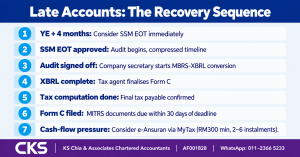
| Step | Action | Date for FYE 30/06/2026 |
|---|---|---|
| 1 | Records not received: KS Chia flag | 31/10/2026 |
| 2 | Apply for SSM EOT (at least 7 days before the circulation deadline of 31/12/2026) | By 24/12/2026 |
| 3 | If SSM grants 3 months: circulate audited financial statements | By 31/03/2027 |
| 4 | Lodge with SSM through MBRS (XBRL) | By 30/04/2027 |
| 5 | Form C due (with e-Filing grace period) | 31/01/2027 (28/02/2027)* |
| 6 | Apply for e-Lanjutan Masa (Route A, with SSM EOT approval): safe window | 01/02/2027 to 13/02/2027* |
| 7 | File Form C by the extended date LHDN approves | As approved |
| 8 | Submit MITRS documents | 30 days after the extended Form C due date |
| 9 | Pay the tax, or apply for e-Ansuran if needed | By the extended due date |
* Subject to the grace period in LHDN’s 2027 return form filing programme. The safe window follows our e-Lanjutan Masa guide.
Notice the clash. With a 3-month SSM EOT, the audited accounts are due by 31/03/2027, but Form C is due by 28/02/2027. That is why the SSM EOT and e-Lanjutan Masa usually go together, and why the SSM one must come first.
Step 1: When Should You Apply for an SSM Extension of Time?
Once records have not arrived four months after the year end, the 6-month circulation deadline is close. Waiting is not neutral. It uses up the remaining time without any safety margin.
- A private company must apply at least 7 days before the last day of the circulation period (SSM Practice Note 3/2018). Late applications are not accepted.
- The fee is RM100 per application.
- The Registrar decides how long to extend. In our experience, 3 months is common.
- After the extended circulation date, the company has 30 days to lodge through MBRS.
- Keep the approval letter. It is the supporting document for Route A of e-Lanjutan Masa.
Step 2: Why Does the Audit Still Take Time After the Extension?
An extension gives time. It does not reduce the audit work. The procedures are the same whether the records came early or late.
The usual bottleneck is not fieldwork. It is how fast the company answers audit queries: bank confirmations, related party balances, hire purchase schedules, director loan confirmations. A two-week delay in answering queries can wipe out the company secretary’s time for lodgement. A company that has already caused one delay by sending records late cannot afford a second one during the audit.
Step 3: How Long Does MBRS XBRL Conversion Take?
Longer than most directors expect. XBRL is not a formatting job. Every line in the financial statements must be tagged to the correct MBRS taxonomy element, validated, and corrected where the system flags a mismatch. Accounts with related party transactions, hire purchase and deferred tax take longer than a simple trading company.
The company secretary cannot start until the audited financial statements are signed. Every day the audit runs late is a day taken from the 30-day lodgement window.
Step 4: When Should You Apply for e-Lanjutan Masa?
The tax agent needs the audited figures to finalise Form C. It does not need the XBRL file, so tax work can run alongside the lodgement. But if the audit will not be signed in time for Form C, apply for e-Lanjutan Masa, LHDN’s online extension for filing the return form.
- Apply no earlier than 30 days, and no later than 14 days, before the Form C due date, including the grace period. An application with less than 14 days left is rejected automatically.
- With an SSM EOT, apply under Route A and upload the SSM approval letter. For a circulation extension, the date to enter is the SSM-approved circulation date plus 30 days.
- Only one approval is allowed per year of assessment.
- The filing and payment deadlines move together.
For the full eligibility rules, rejection codes and MyTax steps, see our e-Lanjutan Masa guide.
Step 5: Does MITRS Get More Time If Form C Is Extended?
Yes, but only by the same amount. Under Section 82B, the MITRS documents are due 30 days after the Form C due date, and LHDN’s MITRS FAQ confirms that the due date takes any approved extension into account. You do not get extra time on top.
The documents are the audited financial statements with the directors’ report and detailed income statement, the tax computation, the capital allowance schedule and any incentive computation. They must be PDF, with a total size of no more than 20MB for the year of assessment. Failure to submit is an offence under Section 120(1)(d), with a fine of RM200 to RM20,000, imprisonment of up to six months, or both. LHDN does not accept extension applications for MITRS itself.
KS Chia Observation
Clients who get an extension often treat it as breathing space. It is working time. With a compressed timeline, the audited accounts, Form C and the MITRS set all have to be ready within the same extended window. Plan the MITRS documents alongside Form C, not after it. For what to check before uploading, see our MITRS pre-submission review.
Step 6: What If the Final Tax Bill Is More Than Expected?
With a compressed timeline, the tax position often gets its first proper look only when Form C is prepared. The balance of tax can then come as a surprise. If cash flow is tight, LHDN’s e-Ansuran service on MyTax allows the balance to be paid in instalments. Based on LHDN’s announcement of 18/03/2025:
- Minimum amount RM300; 2 to 6 monthly instalments
- Covers income tax payable and outstanding tax, including increases and penalties
- Not available for instalment arrangements already in force
- No supporting documents; approved automatically if the criteria are met
- Applied for by the director or director’s representative on MyTax
- Can only be cancelled at an LHDN office, not online
e-Ansuran does not reduce the tax. It only spreads the payment.
What Should Directors Do If Accounts Are Already Late?
- Work out how long is left before the 6-month circulation deadline. If it is getting close, apply for the SSM EOT now; the 7-day cut-off comes quickly.
- Send the auditor a complete pack in one go: bank statements, confirmations, related party schedules, hire purchase agreements and management accounts. A partial pack drags the audit out.
- Answer audit queries within 48 hours wherever possible.
- Ask the tax agent now whether Form C can be filed on time. If not, diarise the e-Lanjutan Masa window.
- Once the tax computation is ready, check the tax payable and decide whether e-Ansuran is needed.
The one step that cannot be undone is missing the SSM EOT cut-off. Once the circulation deadline passes without an approved extension, the company is in breach, and what is left is late lodgement fees and compounds.
KS Chia Observation
The companies that recover cleanly are the ones that accept the position early and work on all fronts at once: SSM EOT, the audit and Form C planning in parallel. Handling one step at a time, and only then thinking about the next, is where most of the extra time is lost.
For why late accounts put pressure on MBRS, MITRS and SSM deadlines in the first place, see our earlier article: Late Audited Accounts 2026: MBRS-XBRL, MITRS and SSM EOT Risk Explained.
Frequently Asked Questions
When must a private company apply for an SSM extension of time?
At least 7 days before the last day of the circulation period for its financial statements, under SSM Practice Note 3/2018. The fee is RM100 per application, and the Registrar decides the length of the extension.
Does an SSM extension also extend the Form C deadline?
No. Form C has its own deadline with LHDN. A company with an SSM extension must separately apply for e-Lanjutan Masa, and can use the SSM approval letter as support under Route A.
When should e-Lanjutan Masa be applied for?
No earlier than 30 days and no later than 14 days before the Form C due date, including the grace period. Applications with less than 14 days left are rejected automatically.
Does the MITRS deadline move if Form C is extended?
Yes. MITRS documents are due 30 days after the Form C due date, and that due date includes any extension approved by LHDN. There is no separate extension for MITRS.
Can a company pay its final tax in instalments?
Yes, through e-Ansuran on MyTax, for amounts of RM300 or more, in 2 to 6 monthly instalments. It is approved automatically if the criteria are met, and it does not reduce the tax payable.
Sources: Companies Act 2016, Sections 258 and 259; SSM, Practice Note 3/2018 on extension of time; LHDN, Garis Panduan Operasi Bil. 4 Tahun 2025 (e-Lanjutan Masa); Income Tax Act 1967, Sections 82B and 120(1)(d); LHDN, MITRS FAQ, updated 26/11/2025; LHDN announcement on e-Ansuran, 18/03/2025. This article is general information and is not tax advice for any specific company. Approval of any extension or instalment arrangement is at the relevant authority’s discretion.
Facing audit or filing deadline pressure?
We handle the audit, SSM EOT, e-Lanjutan Masa, Form C and MITRS in one sequence, so no step waits on another firm. The earlier we are involved, the more options remain. See our statutory audit services and tax consultancy services.
KS Chia & Associates Chartered Accountants (AF001828) | WhatsApp: 011-2366 5233 | Call: 03-6258 3692 | Kepong, Kuala Lumpur