
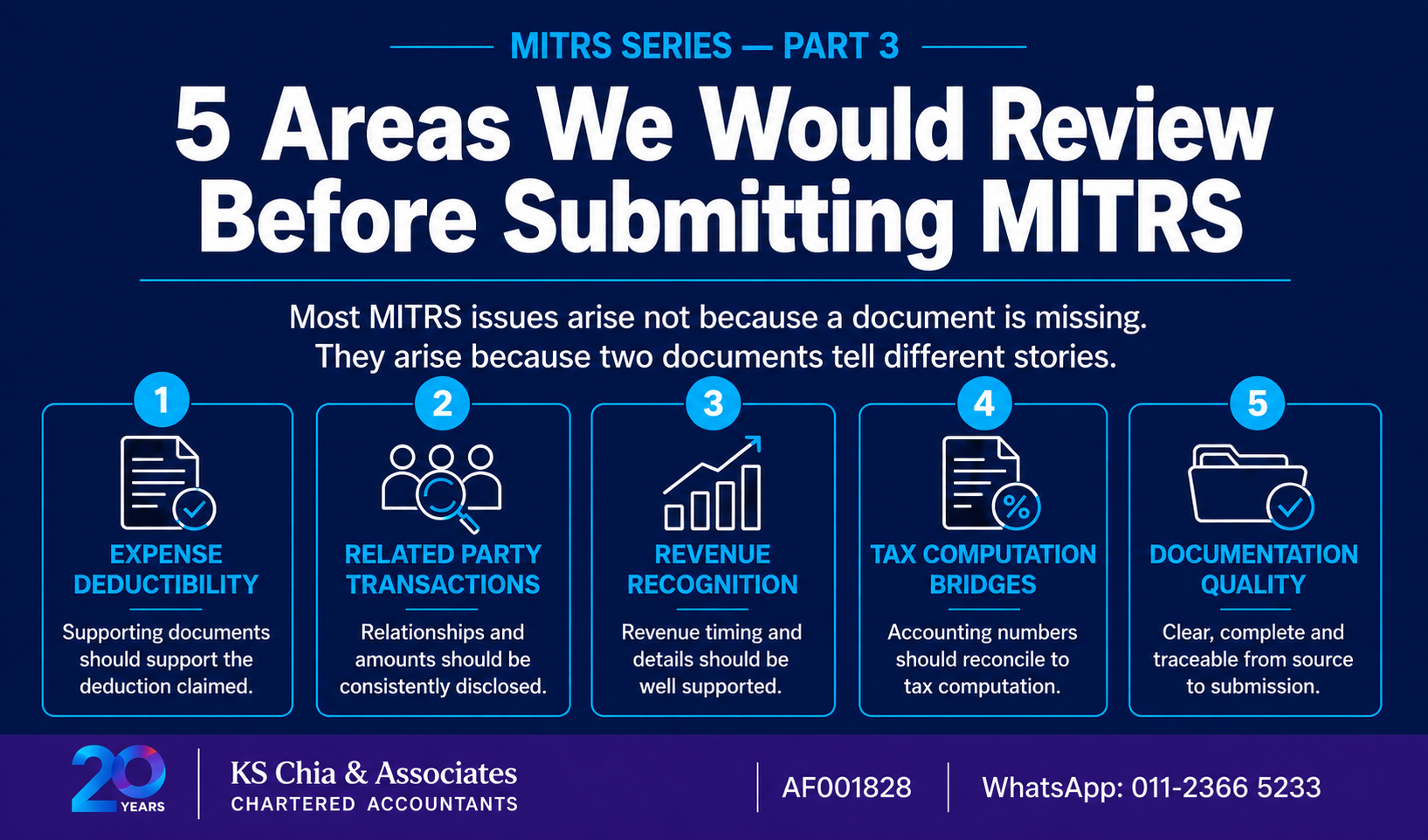
13 Aug 5 Areas We Would Review Before Submitting MITRS
By Kent Chia, Chartered Accountant (Malaysia), Managing Proprietor, KS Chia & Associates (AF001828)
MITRS series, Part 3 of 5 | Published: 13/08/2026 | Last updated: 27/09/2026
SHORT ANSWER
Before a MITRS submission, check that the documents agree with each other in five places: profit before tax in the final accounts against the tax computation and Form C; the fixed asset note against the capital allowance schedule; expense lines in the accounts against the tax add-backs; related party and director balances across the accounts, computation and Form C; and incentive claims in Form C Part D against the incentive computation and approvals. Most MITRS problems come from documents that disagree, not documents that are missing.
Clients sometimes ask what we actually check before we let a MITRS submission go in. The honest answer: we rarely find a missing document. What we find is two documents telling different stories.
It happens because the accounts, the tax computation and the schedules are prepared by different people at different times, and nobody puts them side by side at the end. Before MITRS, that gap usually surfaced only when LHDN opened a tax audit and asked for the full file. Now all four documents reach LHDN together, so the comparison LHDN used to make at audit stage can be made at filing stage. Part 1 covered what the documents show. Part 2 covered whether a claim can be defended. This part is the checklist.
| No. | Compare | Typical gap we find |
|---|---|---|
| 1 | Final accounts vs tax computation and Form C | Computation done on draft accounts; late audit adjustment never carried through |
| 2 | Fixed asset note vs capital allowance schedule | Additions or disposals in one document but not the other |
| 3 | Expense lines in the accounts vs tax add-backs | Large entertainment or professional fees with little or no add-back |
| 4 | Related party note and director balances vs computation and Form C | Director loan balances that differ between Form C and the accounts |
| 5 | Form C Part D vs incentive computation and approvals | Carry-forward balances that do not follow from last year’s schedule |
1. Do the Final Accounts Agree With Form C and the Tax Computation?
The most common problem is version control. Form C and the tax computation were prepared from draft accounts. Then the audit produced an adjustment, such as a provision, an impairment or a reclassification, and profit before tax changed. Nobody went back to the computation.
Under MITRS, the final signed accounts and the computation go in together. If the profit before tax in one does not agree with the opening figure in the other, the difference is there for LHDN to see from the day of submission.
If the audited accounts will not be ready before the Form C deadline, deal with it early rather than file on drafts. An extension through e-Lanjutan Masa may be available; see our e-Lanjutan Masa guide. Where Form C has already gone in on draft figures and the final accounts increase the tax, an amended return under Section 77B is the usual route. It can be filed once, within six months after the Form C due date. Where the final accounts reduce the tax, the route is a claim for relief under Section 131 instead.
Before submission, we check:
- Profit before tax in the final accounts agrees with the opening figure in the tax computation
- Revenue and the other figures in Form C agree with the final accounts
- Each major adjustment in the computation traces to a line in the accounts or a schedule
- Late audit adjustments have been carried into the computation and every schedule
- The accounts being uploaded are the final signed set, not a draft
2. Does the Fixed Asset Note Agree With the Capital Allowance Schedule?
This is where we find the most unexplained gaps. The fixed asset note is prepared by the audit team. The capital allowance schedule is prepared by the tax team, sometimes months apart. Unless someone compares them, they drift.
Read side by side, additions and disposals should match. A disposal in the fixed asset note that is missing from the capital allowance schedule raises the question of whether a balancing charge was left out. An addition claimed in the schedule that does not appear in the accounts raises a different question: was the asset bought at all, or bought in this year?
Before submission, we check:
- Additions in the capital allowance schedule agree with additions in the fixed asset note
- Disposals agree, and balancing charges or allowances have been worked out
- Tax written-down values can be traced to the fixed asset register
- Qualifying expenditure is in the right category under Schedule 3 of the Income Tax Act 1967, with non-commercial vehicle restrictions applied
3. Do the Expense Lines Agree With the Tax Add-Backs?
This is the area closest to Part 2. The accounts show expenses by nature. The computation decides which are fully deductible, partly deductible or not deductible. When the two do not match up, LHDN will ask why.
A common example: the accounts show entertainment of RM80,000, and the computation adds back nothing. That is usually wrong. LHDN sets out its position in Public Ruling No. 4/2015 (Entertainment Expense). Entertainment that passes the Section 33(1) test is only 50% deductible under Section 39(1)(l), unless it falls within one of eight specific categories, such as entertainment for staff, promotional gifts carrying the company logo given to the public, or entertainment wholly related to sales, like food and drinks at a product launch. The ruling’s own examples include Chinese New Year hampers for customers and a dinner for suppliers: both 50%. A nil add-back is possible, but only with a breakdown that shows which category each item falls into.
The same check applies to maintenance and repairs, motor vehicles, travel, professional fees and director-related costs. The question is not whether the expense appears in the accounts. It is whether its tax treatment fits what the expense actually was.
Before submission, we check:
- Large expense lines (entertainment, travel, maintenance, professional fees) are treated in the computation in a way that fits their nature
- Every item claimed in full has a documented basis
- Capital items within legal and professional fees have been identified and added back
- Commission has been checked for Section 107D withholding (see area 4)
4. Do Related Party and Director Balances Agree Across All Documents?
The related party note shows what the company paid to, and received from, its directors, shareholders and related companies. Under MITRS, that note arrives with the computation that treats those payments. The items that most often need attention are management fees to related companies, rent paid to directors or shareholders, and advances to and from directors.
Many directors do not realise how much LHDN already sees here. The YA 2025 Form C asks for loans to directors and loans from directors in the balance sheet particulars, and again for each director in the director particulars appendix. The audited accounts show the same balances in the related party note. With MITRS, both now arrive with the computation. Large debit balances, interest-free advances, long-outstanding amounts, or figures that differ between Form C and the accounts should be sorted out before submission.
Before submission, we check:
- Director loan balances in Form C agree with the related party note and balance sheet
- Related party transactions in the accounts are treated consistently in the computation
- Management fees to related companies are backed by agreements and evidence of services
- Related party rent and other controlled transactions have been reviewed for arm’s length pricing and transfer pricing documentation
- Payments to non-residents have been checked for withholding tax
- Commission to resident individual agents has been checked for Section 107D withholding
5. Do the Incentive Claims Agree With the Approvals and the Business?
Incentive claims are often among the first items a tax auditor looks at, because the tax saved can be large and the conditions are narrow. Pioneer status, investment tax allowance, reinvestment allowance and special deductions each carry their own conditions and computation rules. Under MITRS, the incentive computation sits with LHDN from filing, not only after a CP700.
Two checks matter. First, the claim must agree across the incentive computation, Form C Part D (items D1 to D4) and last year’s carry-forward. Second, the qualifying activity must match the business the accounts describe, in the revenue breakdown, segment note and directors’ report.
LHDN’s MITRS FAQ says approval letters do not need to be uploaded, only the incentive computation. That does not make them optional. They must be on file, and the conditions in them must be met for the year.
Before submission, we check:
- Incentive details and amounts in Form C Part D agree with the incentive computation and the approval letters
- Carry-forward and utilised amounts follow from last year’s schedule
- The qualifying activity matches the business described in the accounts
- Approval letters are on file and their conditions were met for the year
KS Chia Observation
These five checks are not a full audit. They are the cross-checks that, in our files, catch most problems while they are still easy to explain. A MITRS upload that goes through successfully tells you nothing about whether the documents agree. If we cannot explain a difference comfortably before submission, it will not be easier to explain after LHDN writes in.
Frequently Asked Questions
What should be reconciled before a MITRS submission?
Five areas: profit before tax in the final accounts against the tax computation and Form C; the fixed asset note against the capital allowance schedule; expense lines against tax add-backs; related party and director balances across all documents; and incentive claims in Form C Part D against the incentive computation and approvals.
What if Form C was filed on draft accounts and the audited figures changed?
If the final accounts increase the tax, an amended return can be filed under Section 77B, once, within six months after the Form C due date. If the final accounts reduce the tax, the route is a claim for relief under Section 131. The MITRS upload should be the final signed accounts.
Can client entertainment be claimed in full?
Generally no. Under Section 39(1)(l) of the Income Tax Act 1967 and LHDN Public Ruling No. 4/2015, entertainment of clients and suppliers is generally only 50% deductible. A full deduction applies only where the expense falls within one of the specific categories, such as entertainment for staff, promotional gifts with the company logo given to the public, or entertainment wholly related to sales such as a product launch. Chinese New Year hampers for customers are 50% deductible.
Does LHDN see loans to directors?
Yes. The YA 2025 Form C asks for loans to directors and loans from directors in the balance sheet particulars and in the director particulars appendix. The audited accounts show the same balances, and under MITRS both reach LHDN with the tax computation.
Do incentive approval letters need to be uploaded to MITRS?
No. LHDN’s MITRS FAQ states that only the incentive computation is required, not supporting documents such as approval letters. The letters should still be on file, and their conditions must be met for the year.
UPDATE LOG
27/09/2026 — Entertainment example corrected: client entertainment is generally 50% deductible under Section 39(1)(l) and Public Ruling No. 4/2015. Checklist corrected (profit before tax, not revenue, opens the tax computation). Form C director loan items, amended return and Section 131 routes, and the MITRS FAQ position on approval letters added. Short answer, summary table and FAQ added. Source reference corrected to Finance (No. 2) Act 2023.
13/08/2026 — Article published.
Sources: Income Tax Act 1967, Sections 33(1), 39(1)(l), 77B, 82B, 107D and 131 and Schedule 3; LHDN Public Ruling No. 4/2015, Entertainment Expense (29/07/2015); Section 82B introduced by the Finance (No. 2) Act 2023; LHDN, MITRS FAQ, updated 26/11/2025; LHDN Sample Company Return Form (Form C) for YA 2025. This article is general information and is not tax advice for any specific company.
MITRS series: Part 1: What your financial statements tell LHDN | Part 2: Can you defend the claim? | Part 3: Five checks before submission | Part 4: MITRS and e-Invoice | Part 5: MITRS readiness review | MITRS deadline and penalties
Not sure your MITRS documents agree with each other?
A review before submission usually finds gaps while they are still simple to fix. See our statutory audit services and tax consultancy services.
KS Chia & Associates Chartered Accountants (AF001828) | WhatsApp: 011-2366 5233 | Call: 03-6258 3692 | Kepong, Kuala Lumpur