
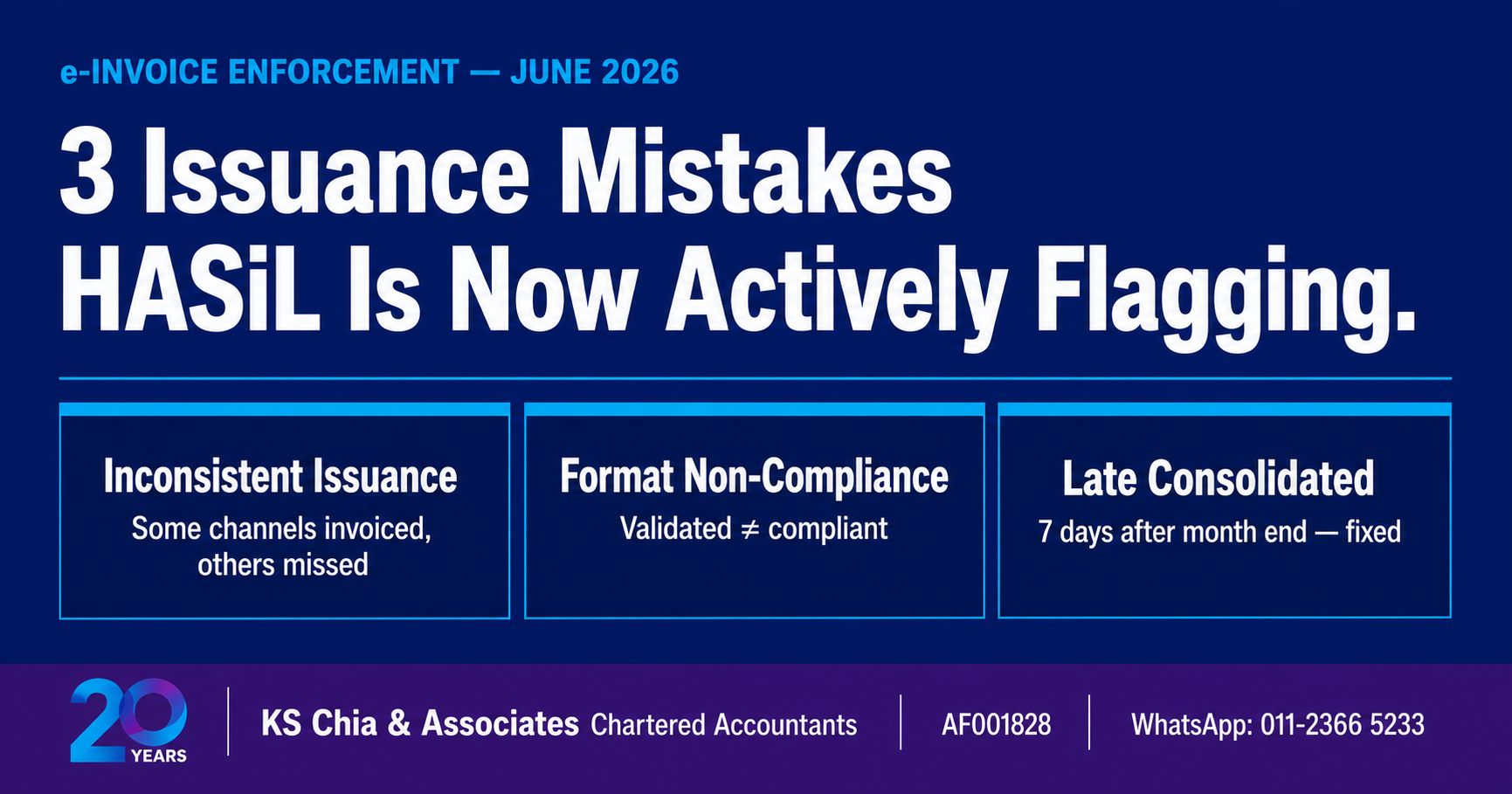
16 Jul 3 e-Invoice Mistakes LHDN Is Flagging — Check Before You Use SVDP
If you identify any of these three gaps in your own e-Invoice records, LHDN’s e-Invoice Special Voluntary Disclosure Programme (SVDP) — open until 31/12/2027 — may allow correction without penalty, subject to conditions. See our full SVDP guide here: e-Invoice SVDP 2026: Correct Your e-Invoice Gaps Without Penalty.
In its 20/06/2026 media statement, HASiL identified four specific e-Invoice non-compliance patterns it is actively monitoring. Three of them — inconsistent issuance, format non-compliance, and late consolidated e-Invoice submission — have not been widely covered. This post deals with those three.
The fourth issue — failure to issue individual e-Invoices for transactions above RM10,000 from 01/01/2026 — is covered separately in our earlier posts on 5 Red Flags LHDN Will See From Your e-Invoice Data and e-Invoice and the LHDN Means Test.
Pattern 1 — Issuing e-Invoices for Some Transactions But Not Others
HASiL described this as issuing e-Invoices for part of your transactions while failing to issue them for subsequent ones. In practice, this usually isn’t deliberate — it’s a workflow split.
The most common version: a business operates across two or more sales channels — for example, invoice-based B2B sales and walk-in cash sales, or online marketplace orders alongside direct sales. The e-Invoice issuance process is wired to one channel but not the other. Months pass before anyone notices the gap, by which point the pattern is visible in the MyInvois data.
KS Chia’s take: This is a systems problem disguised as a compliance failure. If your e-Invoice issuance rate is inconsistent month to month — or varies between sales channels without a documented reason — that inconsistency is exactly what HASiL’s analytics are designed to surface. A one-time reconciliation of your MyInvois log against your full sales record will tell you whether the pattern exists before LHDN identifies it independently.
Pattern 2 — e-Invoices That Do Not Meet the Format Requirements
An e-Invoice submitted to MyInvois and validated is not automatically a compliant e-Invoice. The e-Invoice Specific Guideline prescribes mandatory fields, document types, and content requirements. MyInvois validates the technical submission — it does not check whether every required field has been correctly populated.
Common causes we see: the supplier’s e-Invoice template was set up without reference to the Guideline’s current version; mandatory fields such as the buyer’s TIN or the correct classification code were left blank or incorrectly filled; or the wrong document type was used — for example, a consolidated e-Invoice issued where an individual e-Invoice was required.
KS Chia’s take: A validated e-Invoice and a compliant e-Invoice are not the same thing. If your e-Invoice template hasn’t been reviewed against the e-Invoice Specific Guideline since your implementation date, it’s worth checking now — particularly if your business went live in Phase 1 or 2, where the Guideline has been updated more than once since August 2024. Version 4.8 was published on 07/07/2026 — the most recent update.
Pattern 3 — Consolidated e-Invoices Submitted After the Allowed Window
Consolidated e-Invoicing allows suppliers to aggregate transactions with buyers who do not require individual e-Invoices — typically individual consumers or buyers who have not provided their TIN. The consolidated e-Invoice must be submitted to IRBM within 7 calendar days after the end of the month in which those transactions occurred.
That is a tight window. A business that processes its consolidated e-Invoice submission as part of a monthly accounts cycle — typically completed two to three weeks after month end — is systematically late. The Guideline permits consolidated invoicing; it does not extend the submission deadline to match your close cycle.
KS Chia’s take: Most clients who are late on consolidated e-Invoice submission don’t know they’re late — they assume the end-of-month close timeline applies. It doesn’t. The 7-day window is fixed. If your finance team is processing consolidated e-Invoices as part of the monthly close, that workflow needs to be separated and run earlier. This is a procedural fix, not a system one — but it needs to be done before the next month end.
The Common Thread
All three patterns share the same root: e-Invoice compliance was treated as a one-time implementation task rather than an ongoing operational process. The system was set up, it ran, and nobody checked whether it was running correctly. HASiL’s analytics are now doing that check instead.
The RM10,000 individual e-Invoice requirement — and what it means for data visibility and the means test — is covered in detail in our earlier posts linked above.
KS Chia’s Recommendation: Run a three-point check before your next month end: compare your MyInvois issuance log against your full sales record for the last three months; review your e-Invoice template against the current Guideline version; and confirm your consolidated e-Invoice submission date for last month. If any of the three doesn’t pass, correct it — through SVDP if the gap is historical, or through your workflow before the next cycle closes.
Source: HASiL media statement dated 20/06/2026, “E-Invois Perkukuh Pematuhan Cukai: 52,540 Pembayar Cukai Tampil Laporkan Pendapatan RM4.07 Bilion” (PDF).
Need to Check Your e-Invoice Gaps Before SVDP Submission?
KS Chia & Associates Chartered Accountants (AF001828)
WhatsApp: 011-2366 5233 | Kuala Lumpur