
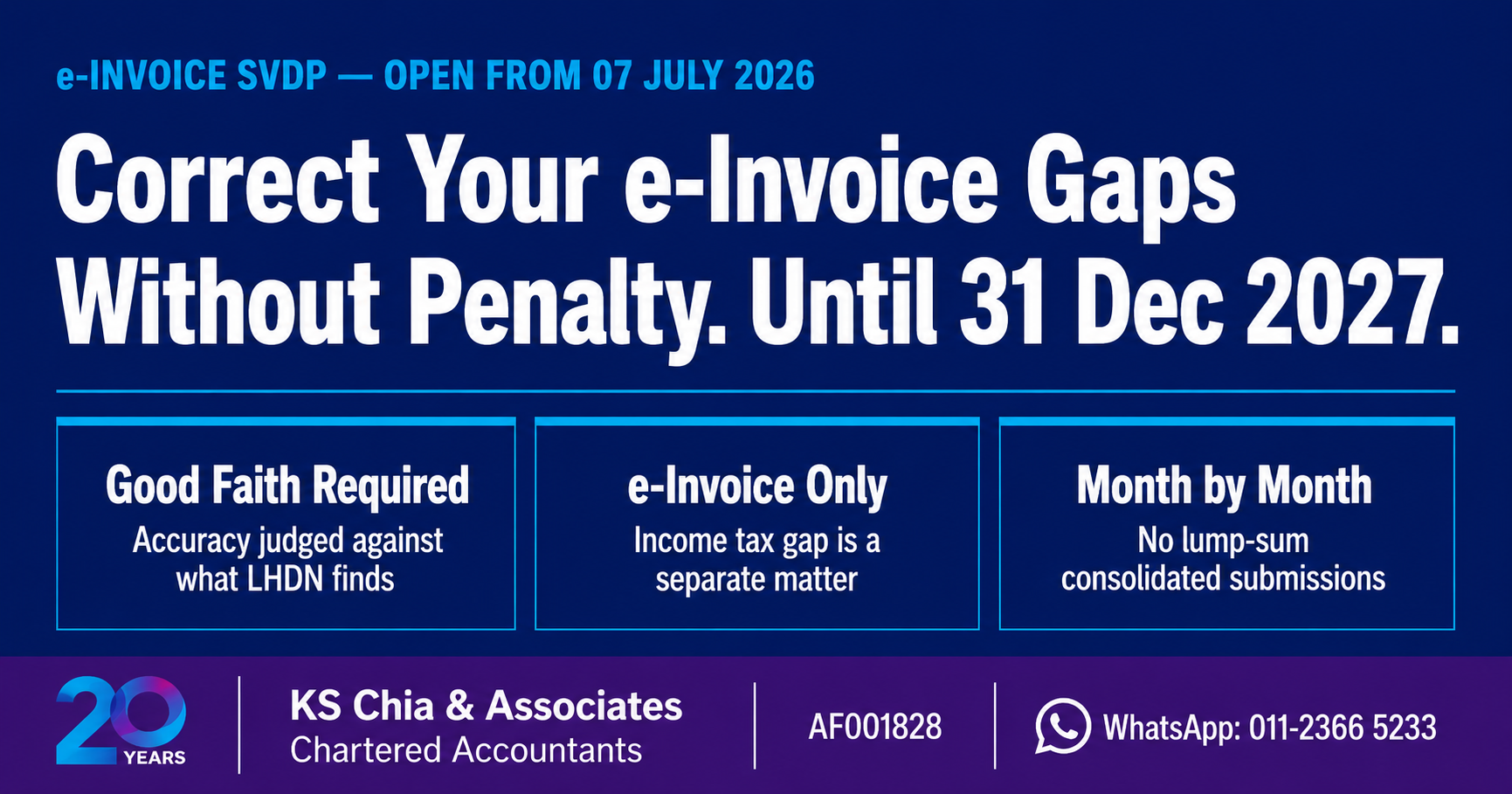
09 Jul e-Invoice SVDP 2026: Correct Your e-Invoice Gaps Without Penalty
On 07/07/2026, LHDN introduced the e-Invoice Special Voluntary Disclosure Programme (SVDP) under Section 17 of the e-Invoice Specific Guideline Version 4.8. Businesses with e-Invoice gaps — missed submissions, format errors, or non-compliant e-Invoices — may now correct their records without penalty until 31/12/2027.
This comes alongside LHDN’s ongoing data-matching efforts, where 52,540 taxpayers have already declared RM4.07 billion in previously unreported income. The window is open — but the enforcement context behind it is real.
Who Can Participate
The SVDP covers four categories:
- Taxpayers who have not submitted, or missed submitting, e-Invoices for any period from their mandatory implementation date
- Taxpayers who submitted e-Invoices containing errors or information that does not comply with the e-Invoice Guideline or Specific Guideline
- Taxpayers who have not submitted any e-Invoices at all for any period from their mandatory implementation date
- Taxpayers currently undergoing, or already notified they will undergo, an e-Invoice compliance review
The fourth category matters: being notified of a compliance review does not automatically disqualify you. But it narrows the window — act before the review concludes, not after.
What SVDP Protection Covers
For e-Invoices properly disclosed under the SVDP, LHDN will not undertake compliance reviews or enforcement actions — including penalties and prosecution — in relation to those disclosed e-Invoices.
What SVDP Protection Does Not Cover
Two categories are explicitly excluded under Section 17.4:
- e-Invoices submitted under SVDP that still do not comply with the Guideline specifications — the SVDP submission itself must be correct
- Voluntary disclosures involving fraud, wilful default, or negligence
Good Faith — What It Means and What It Does Not Guarantee
While the Guideline refers to “good faith,” it does not define it in detail. In practice, the following principles are relevant:
- Good faith requires honesty, bona fide intent, and prudent consideration of all facts — acting with good conscience, not strategically
- Accuracy is judged against what LHDN subsequently finds — not only against your intent at the time of submission. Where a disclosure was found to be inaccurate, LHDN has treated the taxpayer as coming with “unclean hands” and rejected the SVDP outcome
- Even after initial acceptance, LHDN retains the right to revisit and revoke its determination if new information or circumstances arise. A clearance letter is not unconditional finality
- LHDN still performs a computation review on accepted disclosures — mathematical or mechanical errors can affect the outcome even where intent was genuine
Our read: The practical threshold is this — submit what is accurate and complete to the best of your knowledge, through the correct channel, before formal enforcement begins. A known gap that was deliberately deferred is not the same as a genuine systems failure. If you are unsure whether your situation meets that threshold, seek advice before submitting, not after.
The Income Gap Risk — What SVDP Does Not Fix
KS Chia’s take: The SVDP covers e-Invoice compliance only — not income tax. A business that corrects its e-Invoice records under SVDP but still carries a gap between what those corrected records show and what was declared on its income tax return is not protected on the income side. Correcting the e-Invoice record can make that income gap more visible, not less. This is where many businesses get caught — fixing one issue may expose another. If both gaps exist, both need to be reviewed — separately, and in the right order.
Technical Requirements
- Required submission version: Use SVDP 1.2 (without digital signature) or SVDP 1.3 (with digital signature). These versions are for SVDP only — do not use them for standard e-Invoice submissions outside the programme
- Consolidated e-Invoices: Submit month by month — one consolidated e-Invoice per month of transaction per Section 17.6. Lumping multiple months into a single submission is not permitted
- Transactions above RM10,000: For Phase 1–3 taxpayers after their relaxation period, individual transactional e-Invoices are still required for those transactions even under SVDP. The consolidated channel does not apply to them
Programme Period
07/07/2026 to 31/12/2027. Acting early supports the good faith position — a known gap left to run through the SVDP period without correction is harder to defend as prompt rectification if LHDN identifies it independently before you act.
What to Do
A structured approach helps avoid rejection or loss of SVDP protection:
- Review your MyInvois submission log from your mandatory implementation date — identify missed months, format errors, or late consolidated submissions
- Determine whether your gap is a genuine systems failure (good faith arguable) or a known deferred issue (seek advice before submitting)
- If an income gap exists alongside the e-Invoice gap, address both — in the right order and with professional advice
- Use SVDP 1.2 or SVDP 1.3 as the required submission version for all SVDP submissions
- Submit consolidated e-Invoices month by month, not as a lump sum
- Once LHDN processes your accepted disclosure, a clearance letter is typically issued — retain this alongside your submission records for the 7-year statutory period. Note that acceptance can be revisited if LHDN subsequently finds the disclosure was inaccurate or incomplete
Sources: e-Invoice Specific Guideline Version 4.8, Section 17 — e-Invoice Special Voluntary Disclosure Programme, issued 08/07/2026, available at hasil.gov.my/en/e-invoice. Good faith assessment based on High Court and Court of Appeal treatment of SVDP good faith in general SVDP income tax cases and LHDN operational guidelines. No e-Invoice SVDP-specific judicial ruling has been published to date — professional advice is recommended before relying on this framing for material submissions.
Before you submit under SVDP, make sure it is right. A rejected or inaccurate disclosure may lose protection.
KS Chia & Associates Chartered Accountants (AF001828)
WhatsApp: 011-2366 5233 | Kepong, Kuala Lumpur