
22 Jun Late Audited Accounts 2026: MBRS-XBRL, MITRS and SSM EOT Risk Explained
By Kent Chia, Chartered Accountant (Malaysia), Managing Proprietor, KS Chia & Associates (AF001828)
Published: 22/06/2026 | Last updated: 24/09/2026
Time-sensitive: SSM waiver ends 30/09/2026
SSM is waiving late lodgement fees and compounds for Annual Returns and Financial Statements lodged via MBRS 2.0 from 01/09/2026 to 30/09/2026, where the lodgement is more than 7 days and up to 90 days late. No EOT application is needed. The waiver does not apply if the company already has an approved EOT.
If your FS or AR is already late and within 90 days, lodge by 30/09/2026. Source: SSM FAQ, Waiver of Late Lodgement Fees During the MBRS 2.0 Peak Period.
Short answer
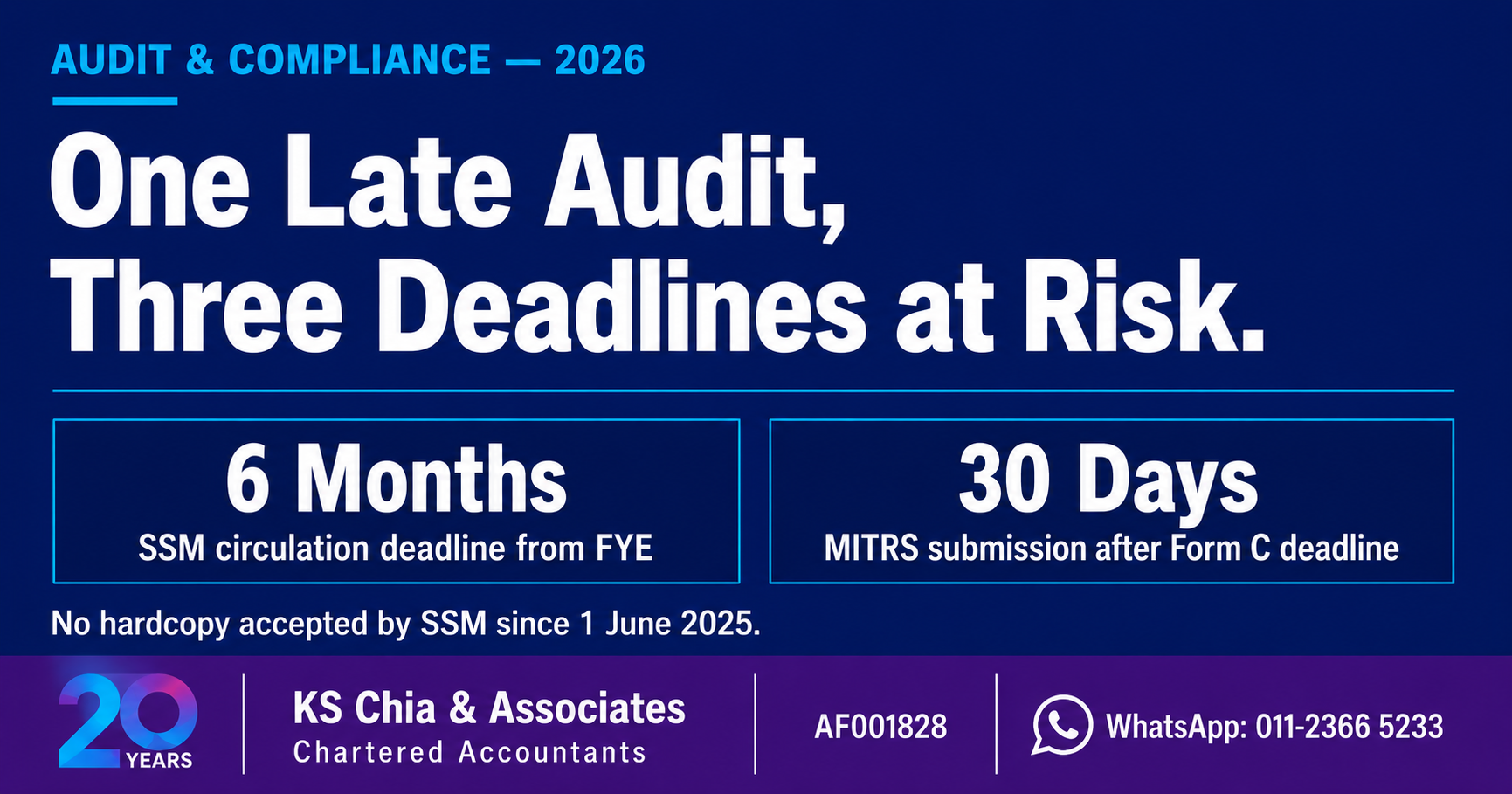
A late audit in 2026 delays three later steps: SSM lodgement of the financial statements in MBRS-XBRL format, Form C filing with LHDN, and MITRS document submission. For a private company, FS must be circulated within 6 months of year-end and lodged within 30 days of circulation. When the audit runs late, an extension of time (EOT) is often the only option left.
Why one late audit now triggers three deadlines
The audit itself is rarely the bottleneck. It is when the documents reach the auditor. Send your records in late, and the delay does not stop at the audit. It runs straight through three more people and three more deadlines: the company secretary, who needs time to convert the audited statements into MBRS-XBRL format; the tax agent, who needs the finalised statements to complete Form C; and then MITRS, the additional document submission LHDN now requires after Form C is filed. By the time all three are queued up, there is often no time left to do any of them properly, and the only way out at that point is an EOT.
What changed: the XBRL bottleneck
Since 01/06/2025, companies must lodge financial statements with SSM in XBRL format through MBRS 2.0. Manual or hardcopy submission is no longer accepted.
Converting an audited financial statement into XBRL is not a copy-paste exercise. It needs accurate mapping of every line item to the MBRS taxonomy, validation checks, and correction of tagging errors when the system flags a mismatch. None of this can start before the audit is signed off.
That is the real problem with a late audit in 2026. A company that finishes its audit with two weeks left before the SSM lodgement deadline has two weeks for taxonomy mapping, validation and correction. Most do not make it in that window.
Which companies are affected?
Every Sdn Bhd and Berhad lodging financial statements with SSM in 2026. This includes audit-exempt companies: they skip the audit, but they still lodge unaudited financial statements through MBRS 2.0, still file Form C, and still submit MITRS documents to LHDN.
The cascade: auditor, company secretary, tax agent
Once documents arrive late, the same delay passes down a chain of three professionals, each working against a separate clock.
Auditor → Company Secretary (SSM): the financial statements must be circulated to members within 6 months of financial year-end, then lodged with SSM in XBRL format within 30 days of circulation. The company secretary cannot start the XBRL conversion until the audit is signed off, and conversion takes real time: taxonomy mapping, validation, correction of tagging errors.
Auditor → Tax Agent (Form C + MITRS): the tax agent needs the finalised audited statements to complete Form C. Once Form C is filed, supporting documents (audited financial statements, tax computation, capital allowance schedule, incentive computations) must go through MITRS within 30 days of the Form C deadline. We have covered the document list, file-size limit and penalty provision separately. See MITRS 2025: Section 82B Document Submission Deadline & Penalties.
If the chain runs out of time, e-Lanjutan Masa: once it is clear the statutory deadline cannot be met, an extension is the only remaining option. Full eligibility routes and the application window are in our separate guide. See e-Lanjutan Masa 2026: LHDN’s Tax Filing Extension System Explained.
None of these three steps runs independently. A delay reaching the auditor narrows the runway for the company secretary and the tax agent both, and by the time that is visible, EOT is usually the only move left.
What are the SSM and LHDN deadlines for audited accounts?
| Process | Deadline | Notes |
|---|---|---|
| SSM: FS circulation | Within 6 months of FYE | FYE 31/12/2025 → 30/06/2026 |
| SSM: FS lodgement (XBRL) | Within 30 days of circulation | No hardcopy accepted since 01/06/2025 |
| SSM: EOT application | At least 7 days before circulation deadline | Apply via MBRS/MyCoID, fee applies. See SSM PN 3/2018 |
| SSM: EOT if approved | +3 months, then 30 days to lodge | FYE 31/12/2025 → original 30/06/2026 → extended to 30/09/2026 → lodge by 30/10/2026 |
| SSM: late lodgement fee waiver | Lodge 01/09/2026 to 30/09/2026 | Delay of more than 7 days and up to 90 days. Not available if an EOT has been approved |
| LHDN: Form C | Within 7 months of FYE | FYE 31/12/2025 → 31/07/2026 (e-filing grace period to 31/08/2026) |
| LHDN: MITRS submission | Within 30 days of Form C deadline | Under s.82B ITA 1967, from YA 2025 |
| LHDN: e-Lanjutan Masa | Apply 30 to 14 days before filing deadline, including grace period | FYE 31/12/2025 → window 01/08/2026 to 16/08/2026 (latest safe date). Under 14 days is auto-rejected (Code 103) |
What you should do
If your FS or AR is already late (before 30/09/2026): check how many days late it is. If it is more than 7 days and up to 90 days late, and no EOT has been approved, lodge by 30/09/2026 to use the SSM waiver. Applying for an EOT now would make the company ineligible for the waiver.
For future years: the only real fix is preventing the chain from starting late. Get your records to the auditor at financial year-end, not weeks or months after, and hand over a complete audit pack the first time: bank confirmations, supplier statements, related-party schedules. Every week saved at this stage is a week the company secretary has for XBRL conversion and the tax agent has for Form C and MITRS.
If the runway has already run out: where there is not enough time for circulation, XBRL lodgement, Form C and MITRS to all land on time, EOT is the only way out. Secure the SSM extension first. An approved SSM EOT becomes supporting evidence if you then need e-Lanjutan Masa under Route A, so the sequence matters: SSM extension before the LHDN one, not after.
KS Chia & Associates recommendation
The deadline that matters most is the one nobody tracks: the date your records reach the auditor. Everything downstream (XBRL conversion, Form C, MITRS) is timed off that one date. Get it right, and the rest follows. Get it wrong, and EOT becomes your only option.
Late audited accounts: frequently asked questions
Is there an SSM late lodgement fee waiver in September 2026?
Yes. SSM is waiving late lodgement fees and compounds for Annual Returns and Financial Statements lodged via MBRS 2.0 from 01/09/2026 to 30/09/2026, where the lodgement is more than 7 days and up to 90 days late. No EOT application is needed, but the waiver does not apply if an EOT has been approved.
What happens if audited accounts are late in Malaysia?
The delay passes to three later steps: MBRS-XBRL conversion and SSM lodgement by the company secretary, Form C by the tax agent, and MITRS document submission to LHDN. Each has its own deadline, and missing them can lead to SSM late fees or compounds and LHDN penalties.
What is the SSM deadline to lodge financial statements?
A private company must circulate its financial statements to members within 6 months of financial year-end and lodge them with SSM within 30 days of circulation. For FYE 31/12/2025, circulation was due by 30/06/2026 and lodgement by 30/07/2026.
Do audit-exempt companies still lodge through MBRS?
Yes. An audit-exempt company skips the audit but still lodges unaudited financial statements with SSM through MBRS 2.0. It also still files Form C and submits MITRS documents to LHDN, so late preparation of accounts creates the same deadline pressure.
Should I apply for SSM EOT or LHDN e-Lanjutan Masa first?
SSM EOT first. An approved SSM EOT can support an e-Lanjutan Masa application under Route A. Note that a company with an approved SSM EOT cannot use SSM’s late lodgement fee waiver, so check the waiver position before applying.
Update log
- 24/09/2026: SSM announced a further waiver of late lodgement fees and compounds for AR and FS lodged via MBRS 2.0 from 01/09/2026 to 30/09/2026 (delay of more than 7 days and up to 90 days; not available with an approved EOT). Article reviewed; audit-exempt companies, Form C dates and the SSM waiver added to the deadline table; FAQ added.
- 01/07/2026: SSM waived late lodgement fees for AR and FS lodged via MBRS 2.0 from 01/07/2026 to 31/08/2026. This waiver has ended.
- 22/06/2026: Article published.
Sources: SSM FAQ, Waiver of Late Lodgement Fees During the MBRS 2.0 Peak Period (01/09/2026 – 30/09/2026); SSM Practice Directive 1/2017 (Revised); SSM Practice Note 3/2018 (EOT); Companies Act 2016, ss.68, 259, 575 and 576; Income Tax Act 1967, s.82B.
Need help coordinating your audit and filing timeline?
KS Chia & Associates Chartered Accountants (AF001828)
Kepong, Kuala Lumpur
WhatsApp: 011-2366 5233 | Office: 03-6258 3692
This article is general information based on SSM and LHDN requirements as at the date of the last update. It is not advice for any specific company.