
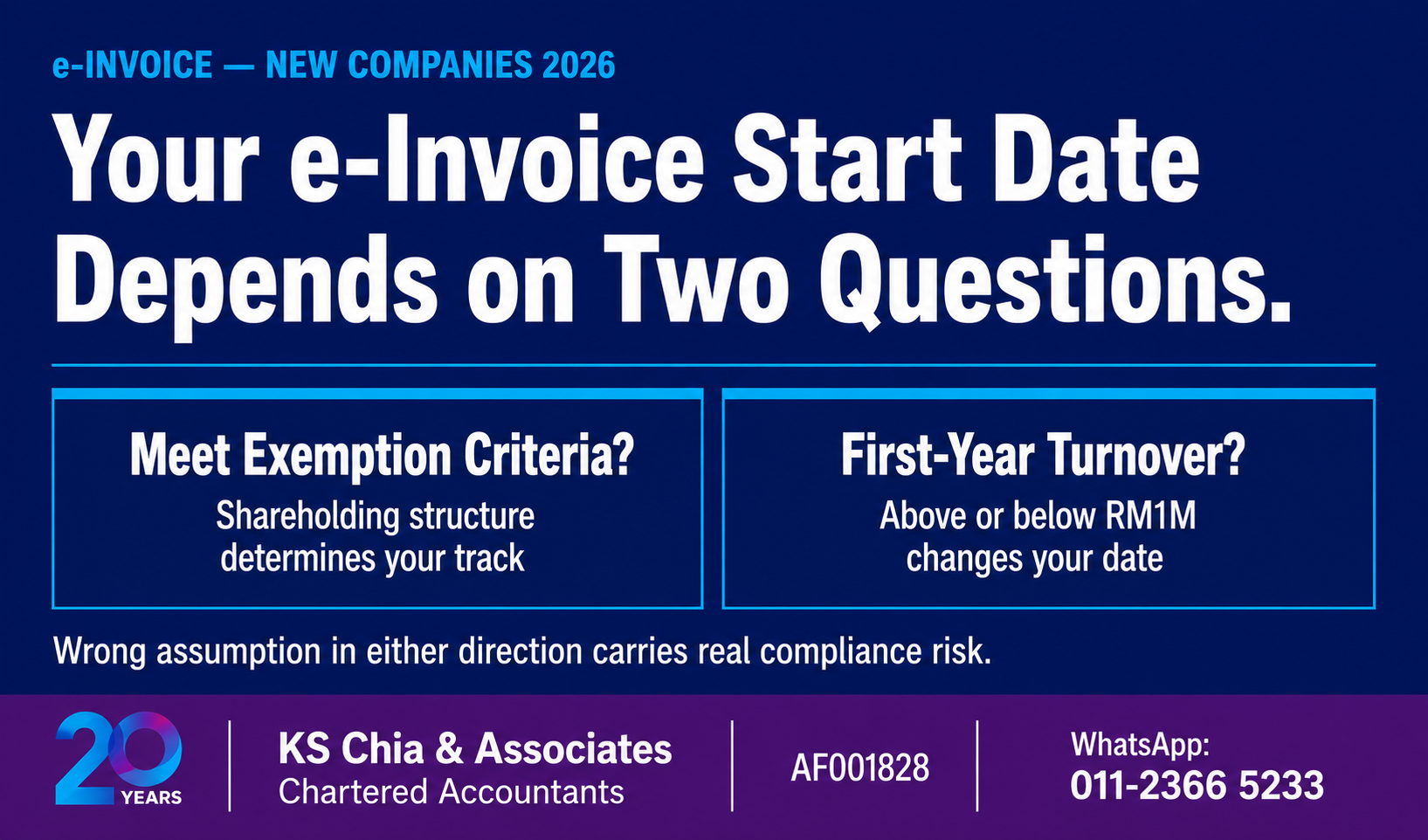
22 Jul e-Invoice for New Companies in 2026: Your Implementation Date Depends on Two Questions
By Kent Chia, Chartered Accountant (Malaysia), Managing Proprietor, KS Chia & Associates (AF001828)
Published: 22/06/2026 | Last updated: 25/09/2026
SHORT ANSWER
A company that commenced operations in 2026 falls into one of three positions. If it is a subsidiary, or has a corporate shareholder, related company or joint venture with turnover of RM3 million or more: e-Invoice from 01/07/2026 or its commencement date, whichever is later. If not, and YA2026 turnover is RM3 million or more: from 01/01/2028. If not, and YA2026 turnover is below RM3 million: exempt.
A new director walked into our office this week convinced his 2026 Sdn Bhd had until 2027 before e-Invoice was his problem. He was half right. The real answer turns on two things he had not looked at — and getting either one wrong creates a problem, in either direction.
Here is how to work out where your company actually stands, using LHDN’s own FAQ examples and the RM3 million exemption threshold that took effect on 01/09/2026. One point before you start: LHDN’s test uses the date your company commenced operations, not its incorporation date. A company incorporated in 2025 that only started trading in 2026 is a 2026 business for this purpose.
What Most People Get Wrong
Two mistakes come through our office regularly, running in opposite directions.
The first: assuming the exemption applies because the company is new and revenue is low — without checking who owns it. A brand new subsidiary with zero revenue still fails the exemption test if the holding company is at RM3 million or more. Structure disqualifies, not numbers.
The second: assuming e-Invoice must start immediately because the company commenced in 2026 — without checking whether it qualifies for deferral. Under LHDN FAQ 14(b), a standalone company with individual shareholders and YA2026 revenue of RM3 million or more does not start until 01/01/2028, not the day it opens.
Both mistakes are avoidable. The answers sit in your SSM filing and your management accounts.
First Question — Who Owns Your Company?
Before turnover even matters, check whether your company can qualify for the e-Invoice exemption at all. Most people skip this step and go straight to the revenue question. Do not.
Under paragraph 1.6.10 of the e-Invoice Guideline, the exemption falls away the moment any one of these applies:
- A non-individual shareholder (or equivalent) with annual turnover or revenue of RM3 million or more holds shares in your company, whatever the size of its stake
- Your company is a subsidiary of a holding company with annual turnover or revenue of RM3 million or more
- Your company has a related company or joint venture with annual turnover or revenue of RM3 million or more
“Related company” takes its meaning from section 2 of the Promotion of Investments Act 1986. LHDN FAQ 103(a) applies it this way for e-Invoice: a company that holds at least 20% of another company, or controls its operations even below 20%, makes those companies related, and companies sharing such a corporate shareholder are related to each other.
If your shareholders are individuals — you, your spouse, a business partner — and there is no group above you, you likely pass. Go to the second question.
If there is a holding company in the picture, or a corporate shareholder at RM3 million or more, the exemption is gone. Go to the third section below.
A brand new subsidiary with zero revenue still fails the test if the holding company is at RM3 million or more. Zero revenue does not help you. The structure is what disqualifies you, not the numbers.
Two further points on the group structure test. A common individual shareholder — even one who is also a director of both companies — does not by itself make two companies related for e-Invoice purposes, and neither does a common director with no shares (LHDN FAQ 103(b) to (d)). Each company is assessed separately. A common corporate shareholder is different. If the same company holds at least 20% of both entities, or controls both, LHDN treats all of them as related companies. If any one of them is at RM3 million or more, the others lose the exemption — including the corporate shareholder itself (LHDN FAQ 103(a)). For the full group structure analysis, see our guide: e-Invoice Exemption Malaysia 2026 — Can Your Business Stop?
Second Question — What Was Your YA2026 Turnover?
If you passed the shareholding check, your company is outside e-Invoice scope until a specific date arrives. No obligation yet. The deferral is the buffer — you do not need the Phase 4 relaxation because the mandate has not reached you.
What determines when it does reach you is your turnover for each year of assessment (YA), which follows your financial year, not the calendar year. Use the revenue in the audited statement of comprehensive income; if the company has no audited financial statements, use the revenue declared in the tax return.
YA2026 turnover of RM3 million or more: e-Invoice starts from 01/01/2028. Nothing required before that.
LHDN example (FAQ 14(b)): Warung Salima commenced operations on 01/01/2026. YA2026 revenue RM3.12 million — at or above the threshold. e-Invoice start date: 01/01/2028.
Guideline vs FAQ: paragraph 1.5 of the e-Invoice Guideline (Version 4.8) is worded differently. It sets 01/07/2026 or the commencement date as the default for businesses starting from 2026, and gives the deferred date only where first-year turnover is expected to be below RM3 million. LHDN’s FAQ 14(b), issued later on 04/09/2026, applies the deferred 01/01/2028 date to Warung Salima even though her first-year revenue was RM3.12 million. We follow the FAQ example, but a new company expecting RM3 million or more in its first year should confirm its start date with LHDN in writing before relying on the deferral.
YA2026 turnover below RM3 million: exempt — provided you pass the group structure test. The obligation only starts from 01/01 of the second year after the first YA in which turnover reaches RM3 million. If it never does, the mandate never applies.
LHDN example (FAQ 14(b)): Pinggan Mangkuk Enterprise commenced operations on 01/01/2026. YA2026 revenue RM308,000 — below RM3 million, so exempt. YA2027 revenue RM3.14 million — at or above the threshold. e-Invoice start date: 01/01/2029, the second year after YA2027.
One thing directors miss: the clock starts in the year you reach RM3 million, not the year you file accounts or realise the number. If your YA2026 closes at RM3 million or more, the 01/01/2028 date is locked in — whether or not your accounts are finalised yet. And once that start date is fixed, a later drop below RM3 million does not restore the exemption.
Failed the Shareholding Test? Here Is Your Position
Your e-Invoice start date is 01/07/2026 or your operation commencement date, whichever comes later. You are in scope from that day, whatever your own revenue.
LHDN example (FAQ 14(a)): Coco Lock Sdn Bhd, a subsidiary of a Phase 1 group, commenced operations on 01/09/2026. Start date: 01/09/2026 — later than 01/07/2026, so the commencement date applies.
Being in scope does not mean you need everything running perfectly from day one. The interim relaxation period runs until 31/12/2027 for the 01/01/2026 and 01/07/2026 implementation dates (LHDN FAQ 113), and during this window consolidated e-Invoices are allowed for all transactions. FAQ 113 does not list later start dates, so if your company commenced after 01/07/2026, confirm the position with LHDN before relying on the relaxation.
The relaxation is not permission to do nothing. Consolidated e-Invoices must still reach IRBM within 7 calendar days after month end — that is a fixed window, not your monthly close date. Missing it is a compliance gap, not an administrative oversight.
Where Does Your Company Stand?
| Situation | Condition | e-Invoice start date |
|---|---|---|
| Fails group structure test | Subsidiary, or corporate shareholder, related company or joint venture at RM3 million or more | 01/07/2026 or commencement date, whichever is later. Phase 4 relaxation until 31/12/2027 |
| Passes group structure test; YA2026 at RM3 million or more | Individual shareholders, no group, YA2026 turnover RM3 million or more | 01/01/2028 (LHDN FAQ 14(b); confirm with LHDN, see note above) |
| Passes group structure test; YA2026 below RM3 million | Individual shareholders, no group, YA2026 turnover below RM3 million | Exempt — until turnover reaches RM3 million, then 01/01 of the second year after that YA |
Frequently Asked Questions
When does a company that started in 2026 need to issue e-Invoices?
It depends on who owns the company and its first-year turnover. A subsidiary or group company starts from 01/07/2026 or its commencement date, whichever is later. A standalone company with individual shareholders and YA2026 revenue of RM3 million or more starts on 01/01/2028. A standalone company below RM3 million is exempt until it reaches the threshold.
Is the RM3 million threshold based on financial year or calendar year?
Year of assessment, which follows the company’s financial year. For a 31 December year-end, YA2026 covers 01/01/2026 to 31/12/2026. Use revenue in the audited statement of comprehensive income, or the tax return if there are no audited accounts. The start date is 1 January of the second year after the YA in which revenue first reaches RM3 million.
If my YA2026 revenue is below RM3 million, am I permanently exempt?
No. You are exempt until revenue reaches RM3 million, provided you keep passing the group structure test. You must then start e-Invoice from 1 January of the second year after that YA. Once a mandatory start date is fixed, a later drop in revenue below RM3 million does not restore the exemption.
What did the September 2026 change mean for a 2026 company?
The exemption threshold rose from RM1 million to RM3 million with effect from 01/09/2026, under e-Invoice Guideline Version 4.8. A standalone 2026 company with revenue between RM1 million and RM3 million is now exempt, provided it passes the group structure test in paragraph 1.6.10. A company that fails the group structure test is not helped by the change.
My company has a corporate shareholder. Must I implement e-Invoice?
If that shareholder’s own turnover or revenue is RM3 million or more, yes, whatever its stake. If it is below RM3 million, it does not disqualify you by itself. But if it holds at least 20% of, or controls, both your company and another company at RM3 million or more, LHDN treats the companies as related (FAQ 103(a)) and you lose the exemption.
Two Questions. Answer Them Now.
Assuming you are exempt when your shareholding structure disqualifies you means non-compliance from your commencement date — potentially already months behind. Assuming you must implement immediately when you qualify for deferral means spending time and money on a system you do not need yet.
Check every entity connected to you that might trigger the disqualification. And if your YA2026 turnover is anywhere near RM3 million, track it now. The date locks in based on when you reach the threshold, not when your accountant tells you about it.
UPDATE LOG
25/09/2026 — Threshold revised from RM1 million to RM3 million following the Prime Minister’s announcement on 30/08/2026 and IRBM e-Invoice Guideline Version 4.8. LHDN FAQ 14 examples updated to LHDN’s RM3 million figures (Warung Salima RM3.12 million; Pinggan Mangkuk YA2027 RM3.14 million). Group structure test, revenue basis, commencement-date point, FAQ and internal links added.
22/06/2026 — Original article published.
Sources: IRBM e-Invoice Guideline Version 4.8, paragraphs 1.5, 1.6.1(e) and 1.6.10, published 30/08/2026. LHDN e-Invoice General FAQ, updated 04/09/2026, FAQs 14, 99, 101, 103, 104 and 113. Promotion of Investments Act 1986, section 2. This article reflects LHDN’s published position as at 25/09/2026 and is intended as general guidance only. It does not constitute legal or tax advice for any specific engagement.
Not sure which track your company is on?
Send us your SSM filing and latest management accounts. We will confirm your group structure position and your implementation date before you commit to a system or miss a deadline.
KS Chia & Associates Chartered Accountants (AF001828) | WhatsApp: 011-2366 5233 | Office: 03-6258 3692 | Kepong, Kuala Lumpur