
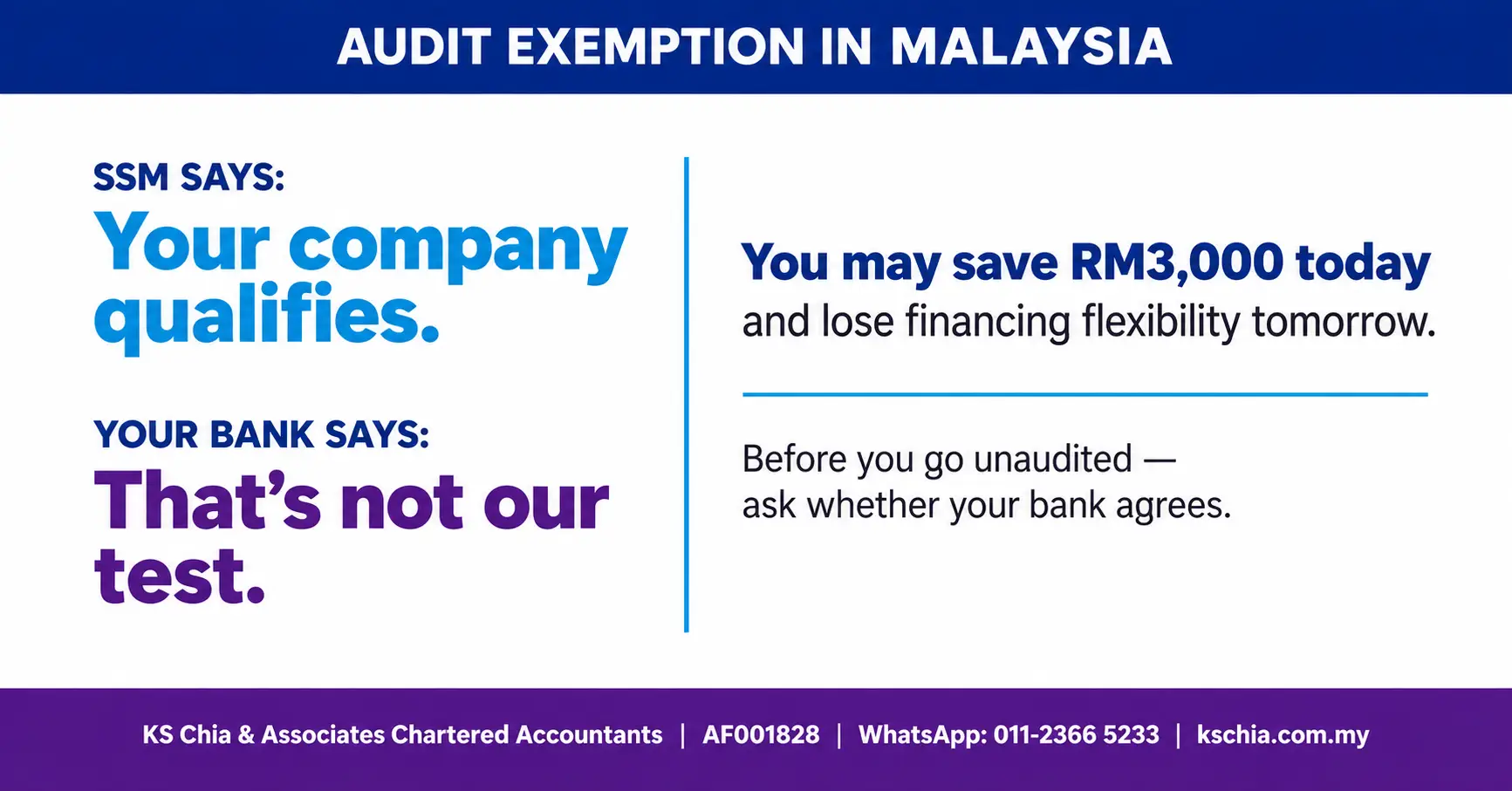
24 Sep Audit Exemption Malaysia 2025–2027: Your Company Qualifies. Your Bank Might Not Agree.
By Kent Chia, Chartered Accountant (Malaysia), Managing Proprietor, KS Chia & Associates (AF001828)
Published: 24/09/2026 | Last updated: 24/09/2026
Short answer
Audit exemption in Malaysia under SSM Practice Directive 10/2024 only removes the statutory audit requirement for SSM filing. It does not bind your bank. Banks apply their own credit policies and may still require audited financial statements, or test unaudited figures against your bank statements, before renewing a facility.
A client with year-end 31 December 2025 asked us to prepare unaudited financial statements. Turnover and total assets were both under RM1 million. If the two preceding financial years were within the same limits, the company qualifies for audit exemption in Malaysia under SSM’s new framework.
The same company has a banking facility.
That is the decision most directors get wrong. They treat audit exemption as a cost-saving switch. It is not. It is an SSM filing option. The bank is a separate counterparty with a separate test, and it is not bound by what SSM allows.
Does audit exemption mean the bank will accept unaudited accounts?
No. SSM Practice Directive 10/2024 tells you whether your company can skip the statutory audit for filing purposes. It says nothing about what your bank will accept when it reviews your facility.
Banks set their own requirements. Some require audited financial statements regardless of company size. Others cross-check your declared figures against your actual bank statement activity. None of them are bound by what SSM allows.
The MIA FAQs on Audit Exemption (first published 29 December 2025) make this explicit: whether a bank or government agency will accept unaudited financial statements depends on that institution’s own policies and risk framework. Audited statements are generally preferred. Some may accept unaudited accounts only with additional supporting documents or collateral. LHDN may accept unaudited accounts from a qualifying company unless it specifically requires otherwise. That position does not extend to your banker.
Audit exemption is a legal question. Whether unaudited accounts work for your business is a commercial question. The two answers are not always the same.
What one major Malaysian bank told us (September 2026)
In September 2026 we clarified current practice with a major Malaysian bank at branch level. This was a verbal clarification, not a written policy and not a Bank Negara Malaysia circular. It shows how one bank is handling files today. Other banks will differ, so check directly with your relationship manager before deciding.
| Client turnover | Bank practice |
|---|---|
| Above RM3 million | HQ will normally require audited financial statements for facility review. Submitting unaudited accounts in this band may result in additional review requirements and could affect continuation of the facility. |
| RM3 million and below (Sdn Bhd or sole proprietor) |
The bank cross-checks cash inflows on the bank statements against the turnover declared in the unaudited financial statements or tax form. Example: RM2.4 million turnover means the bank expects roughly RM200,000 a month coming through the account. The figures must be consistent. |
The “above RM3 million” band is not academic. A company can have turnover above RM3 million and still qualify for audit exemption from Phase 3 onwards, because only two of the three criteria need to be met. If total assets and employee numbers are within the limits, SSM allows unaudited accounts. This bank would not.
So even when SSM allows unaudited accounts, the bank is still testing whether the numbers are real. The exemption removes your audit obligation to SSM. It does not remove your obligation to satisfy the bank that your declared figures are supportable.
Why companies end up paying twice
This sequence is not unusual:
- Director chooses unaudited accounts to save the audit fee.
- Accounts are finalised, lodged with SSM, and used for tax filing.
- The bank reviews the facility and asks for audited financial statements.
- The company then wants the same year audited, after the work is already done.
- Two fees. Time pressure. Facility under review.
That outcome is avoidable if the bank question is asked at the start, not after lodgement.
Three questions to ask before choosing unaudited accounts
Ask these before confirming the engagement, not after the draft is ready:
- Does the company currently hold any banking facility — overdraft, term loan, trade line, bank guarantee, or similar?
- Has the bank previously asked for audited financial statements at review or renewal?
- Will you renew, restructure, or apply for new facilities in the next 12 to 18 months?
If any answer is yes, treat unaudited financial statements as a commercial risk, not a default. Ask the bank’s relationship manager, in writing, whether unaudited accounts will be accepted for the next review. Keep the reply on file.
If you still choose unaudited accounts while facilities are in place, do so with full awareness: the bank can still demand an audit later, and that is a separate engagement at additional cost.
Audit exemption thresholds in Malaysia for 2025, 2026 and 2027
Not every company that thinks it qualifies for audit exemption does. Under SSM Practice Directive 10/2024, a private company must meet at least two of three criteria for the current financial year and the two preceding financial years. The preceding years are tested against the same phase thresholds as the current year.
The thresholds also change each year:
| Phase | Financial period | Turnover (RM) | Total assets (RM) | Employees |
|---|---|---|---|---|
| Phase 1 | Commencing on or after 1 Jan 2025 until 31 Dec 2025 |
≤ RM1 million | ≤ RM1 million | ≤ 10 |
| Phase 2 | Commencing on or after 1 Jan 2026 until 31 Dec 2026 |
≤ RM2 million | ≤ RM2 million | ≤ 20 |
| Phase 3 | Commencing on or after 1 Jan 2027 |
≤ RM3 million | ≤ RM3 million | ≤ 30 |
Sources: SSM Practice Directive 10/2024; MIA FAQs on Audit Exemption (29 December 2025).
Example: for a 31 December year-end, FYE 31 December 2025 qualifies under Phase 1 only if FYE 2023, 2024 and 2025 each meet at least two of the Phase 1 limits.
Exemption is also optional. A company that qualifies can still choose to be audited, and often should, particularly where lenders, investors, or grant bodies are involved.
A company that passed the threshold test last year may not pass it this year if turnover or headcount has grown. Check the numbers before assuming exemption still applies.
The bigger picture — not just this year’s fee
Unaudited financial statements are the right call for a clean company with no borrowings, no planned tender, and no investor on the horizon.
They are a harder call if you are using the bank’s money, bidding for government or corporate contracts, or may need a facility within the next year. Exemption saves compliance cost now. It narrows options later.
A few points directors sometimes overlook:
- Directors still approve and sign the financial statements, audited or not, and must still lodge them with SSM together with the directors’ report and the audit exemption certificate.
- Members holding at least 5% of the voting shares, or at least 5% of the members, can require an audit by written notice given no later than one month before the financial year-end (paragraph 14, PD 10/2024). The Registrar can also direct an audit.
- Grant bodies, government agencies, and counterparties can still decline unaudited accounts for their own purposes.
- None of that is resolved by the audit exemption certificate.
KS Chia & Associates — Our position
Do not start from “are we eligible?” Start from “who will read these accounts in the next 18 months?”
SSM eligibility is the easy part. The bank’s file is the part that moves cash. If those two answers conflict, an audit is not a luxury. It is cheaper than a facility review after the unaudited set has already gone out.
If you are deciding between audited and unaudited accounts and you have a banking facility, tell us the facility position before we start the accounts. That conversation belongs at engagement acceptance.
Frequently asked questions
Will my bank accept unaudited financial statements if my company qualifies for audit exemption?
Not necessarily. SSM audit exemption only covers statutory filing. Each bank applies its own credit policy. According to the MIA FAQs, audited statements are generally preferred, and a bank that accepts unaudited accounts may ask for supporting documents or collateral. Confirm with your relationship manager in writing before deciding.
What are the audit exemption thresholds in Malaysia for 2025, 2026 and 2027?
Under SSM Practice Directive 10/2024, a private company must meet at least two of three limits: turnover and total assets not exceeding RM1 million (2025), RM2 million (2026) or RM3 million (2027 onwards), and employees not exceeding 10, 20 or 30. The limits apply to the current and two preceding financial years.
Can a company with turnover above RM3 million qualify for audit exemption?
Yes, from Phase 3, if total assets do not exceed RM3 million and employees do not exceed 30 for the current and two preceding financial years. Only two of the three criteria must be met. Banks may still require audited accounts at that turnover level.
Can shareholders still require an audit if the company is exempt?
Yes. Under paragraph 14 of PD 10/2024, members holding at least 5% of the voting shares, or at least 5% of the members, can require an audit by written notice no later than one month before the financial year-end. The Registrar can also direct an audit.
Will LHDN accept unaudited financial statements?
According to the MIA FAQs, LHDN may accept unaudited financial statements from a company that qualifies for audit exemption, unless LHDN specifically requires audited accounts. This does not change what your bank or other counterparties will accept.
Not sure which applies to your company?
Contact us before we finalise your accounts. We will walk through the bank facility position with you and confirm whether audited or unaudited accounts are the right call.
KS Chia & Associates Chartered Accountants (AF001828)
Kepong, Kuala Lumpur | WhatsApp: 011-2366 5233 | kschia.com.my